
I was lucky enough to have time off (snowstorm, school canceled) to read this book, “Libertad” by Bessie Flores Zaldívar, because I couldn’t put it down. You can’t fake real and this novel was real. It’s also hard to make me cry, but this story did that too. Thank you, Bessie Flores Zaldívar, for writing this novel.

The main characters in this book are teenagers so this book is classified as Young Adult, but this coming-of-age story is enjoyable to read as an adult. The reader gets to follow Libertad for about a year as she is trying to navigate what she wants for herself and deciding who she is, and how that affects her relationship with her friends and family members. When the story begins, she is 17 years old, living with her Abuela, Mami, and 2 brothers, during the political unrest of the 2017 presidential election in Honduras. This isn’t just a backdrop to the story, it’s an essential part of navigating her school, friend, romantic, and familial relationships.
Having complicated feelings about a country’s political situation and its effect on your family is as familiar to me as Libertad’s go-to snack of plantain chips and coke. My mom and her family immigrated to the U.S. from Cuba and I grew up hearing about the political and social situations in Cuba so often that when I went to college I basically majored in it, hoping I could make more sense of it. People usually want clear-cut answers from me about what I think about Cuba and the United States. The truth is, I can see good and bad from many perspectives. It’s complicated! Bessie Flores Zaldívar understands this, and that’s what makes this novel so compelling. She knows that to truly understand someone’s perspective, you have to know the background to their story and that people come to their beliefs because of their experiences and the details that make up their lives. And sometimes they come to conclusions that just seem wrong, or sometimes they are right, but it’s also tragic. What is the line to what you give up, personally? Is it worth your life? These are the kinds of questions that her characters are thinking about as they live in Honduras, but these are also questions anyone might have when they decide to try to come to the United States. Whoever thinks that question is simple hasn’t spent the time to really consider the prices that people have to pay, both for staying in their country and for leaving it. I like reading stories that really dig into this theme, because there is so much to explore and so much that I know inside of my soul but I don’t know that I could really put to words. That’s what this novel does.
I cried during the book because of the way things work out for some characters, but I also cried reading the author’s note at the end to the reader. In this letter, the author wondered how her conversation with the main character, Libertad, would go, knowing how things ended up politically after 2017. As so many of these political situations are playing out across Latin American countries, I just keep thinking of people who are there everyday, like all the characters in the book, those who stayed and those who left, studying and working without hope of a day off. They know that things could be better, but that they could also be worse. I wanted to freeze in time the night that Libertad, Dani, Maynor, and Alicia get to spend at Alicia’s apartment after the poetry reading at Cien Años. In another country, like even in the United States, it would be nothing to have so many nights like that. I know, because I have experienced them, especially when I was college-aged. The author really captures how it feels for Libertad, her brother, and their friends to be alive and present in the moment. I cried knowing that the moment would likely not last.
The novel is written in English but incorporates Spanish throughout in a way that I enjoyed. There are footnotes if you don’t know the language, but those parts in Spanish just had to be said in Spanish, especially the poems. It all flowed fine, in my opinion. I liked it that the Spanish was not italicized, so it didn’t feel like it was being otherized. The story just wove between English and Spanish without drawing too much attention to itself.
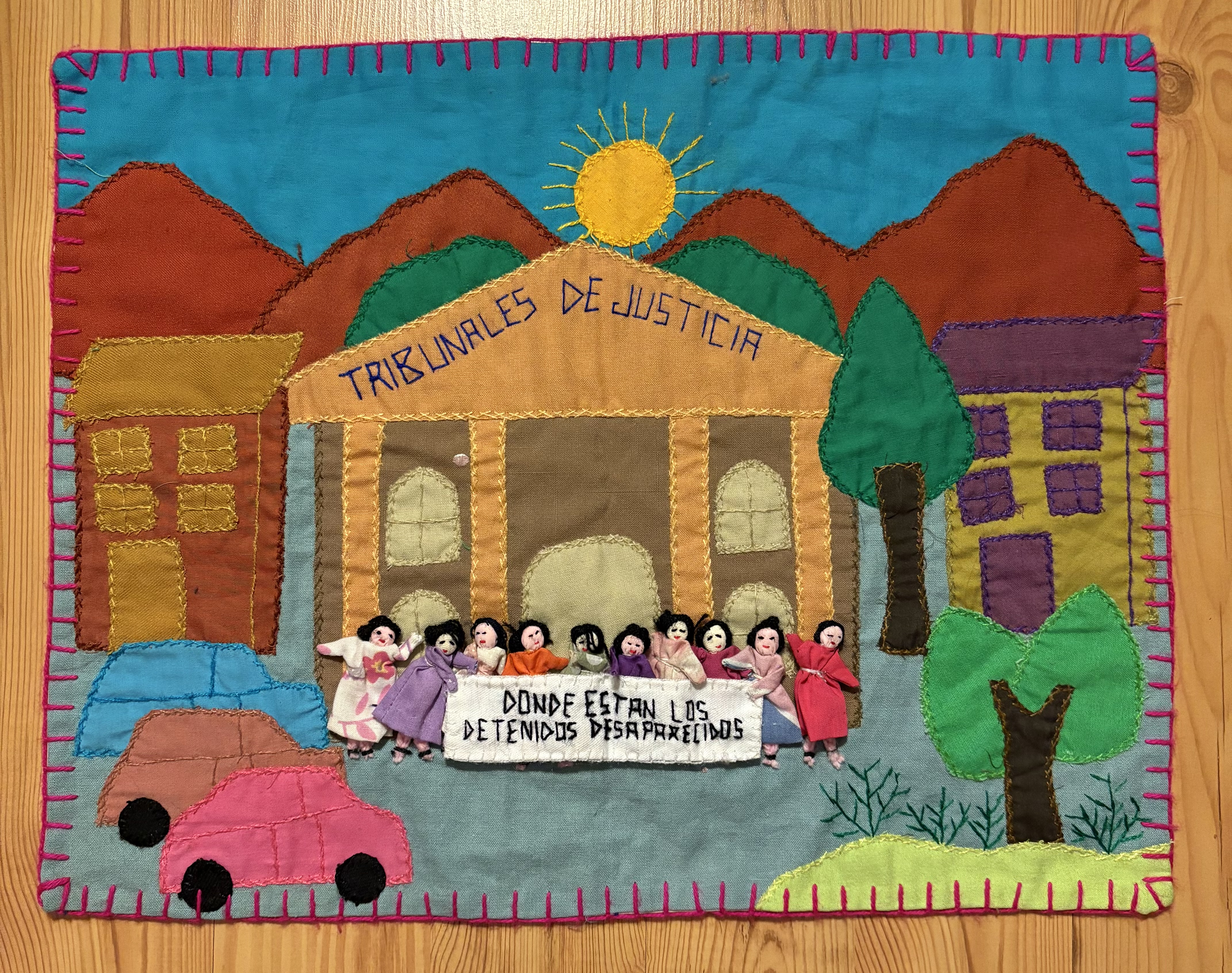
I’m so happy I got to read this book and get to know Libertad. It reminded me of this arpillera my mom bought in the early 90s, from someone who was selling them to raise awareness and funds for The Disappeared in Chile, under the rule of Pinochet. To talk about these topics and explain them, as difficult as they are, is a form of protest. You can read this book, “Libertad,” both for enjoyment, because it is a good story, but also as a way to keep the idea alive that maybe a better world is possible. Maybe. I highly recommend it. Let me know if you read it, there is a lot to discuss.
 Silvia Gisela